By Peter Casserly
In the years following World War 2, France and its citizens enjoyed a once-in-a-lifetime surge of economic and cultural prosperity. The 1950s and 1960s delivered year on year economic growth often as high as 4%. It only slowed once the 70s arrived. Living standards were booming. The French fell in love with their gadgets, their cars, their exciting new fashion, and going to the cinema to see homegrown stars like Catherine Deneuve and Alain Delon.
This period, defined as 1945 to 1975, became known as Les Trentes Glorieuses, which translates precisely as The Thirty Glorious. The term was coined by an economist in his 1979 publication, and stuck. The French didn’t know it at the time. They were just busy soaking up spring and summer sunshine in their beautiful new fashion and being French. The streets were huffing to the scent of Gauloise cigarettes and humming to the constant thrum of Citroen DS fan noise. President Charles de Gaulle was busy wearing funny hats, being mercurial, and just being Charles de Gaulle. On the morning he, his wife, and chauffeur sped through a hail of machine gun fire in his DS, and survived, you could probably say he was very busy.
The Citroen DS, particularly black ones just like de Gaulle’s, came to personify the best of French culture, chic, design and manufacturing. The car was in demand for movie and television appearances, and was the firm favourite among the diplomatic and government corps.
Around the bend at Sochaux and Boulogne-Billancourt, it rankled. Renault had nothing more than a dated range of upright small cars and the newly minted 16. Their quite conventional Fregate sedan was not replaced after its 1951-1960 production run. For a short time, Renault assembled the Rambler Classic in Belgium, calling it the Renault-Rambler. It sold a number somewhere between novelty and decent, but had no real future as a DS challenger. They assembled the ‘64 and ‘65 model years, and after that, it was done. Peugeot had the 404 and the new, smaller 204 and not much else.

France needed another top-line car. In 1966, Renault and Peugeot decided they’d do one together. No time was wasted. They commenced work on the newly named Projet H with urgency.
Renault would engineer the car. Peugeot would design an all-new 3.5 litre 90 degree V8. Each would have differing bodywork on the same rear wheel drive underpinnings.
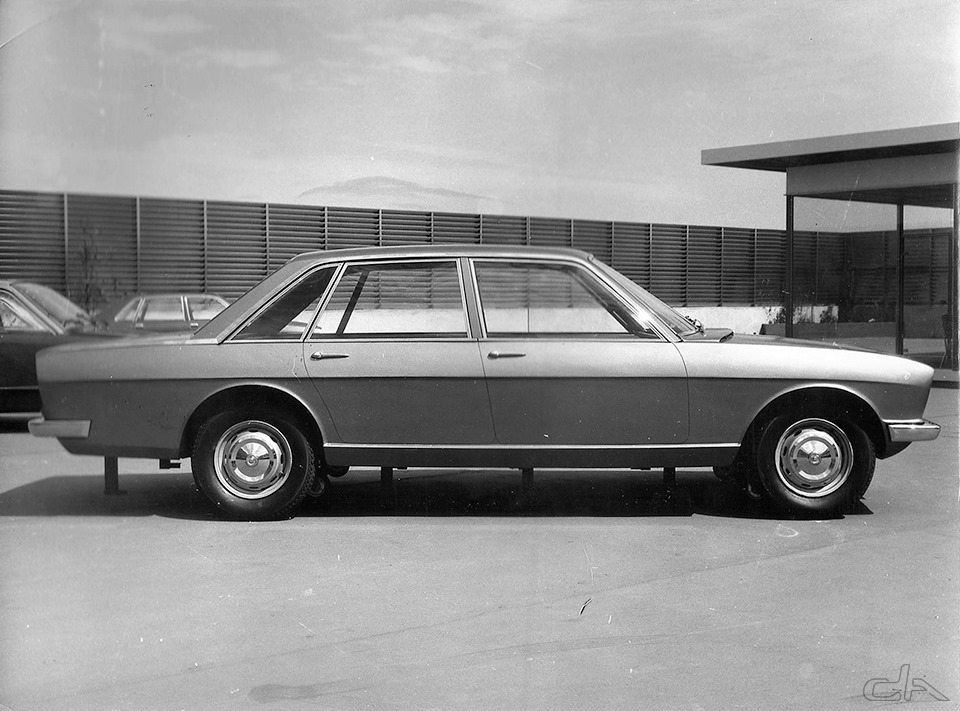
Renault’s Projet H was a hideously baroque, heavy, slab-sided monstrosity with a sad drooping tail. Unable to do the job themselves, Peugeot enlisted their reliable friends at Pininfarina. A Mr Aldo Brovarone – yes, the man who designed your 504 – penned a breezy, light-filled design with slim pillars and neatly chamfered surfacing.


Renault tried a few different styling ideas for Projet H. Only the fastback sedan survived and resides now in Renault’s museum. Wiper Pride was big in the styling studios in the sixties, for some strange reason.
The Renault design was developed the furthest. The sole survivor of the quartet of Projet H cars photographed on the rooftop of Peugeot’s La Garenne styling studio at least had the honour of being a complete car. It can now be seen inside Renault’s museum. It’s not pretty. The bright hubcaps have long disappeared and there’s a dark dullness to the rest of the car that just goes to prove how difficult it is to keep these things looking good. All they’re supposed to do is have a lifespan of a few months for top-secret display and assessment purposes. It is nearing 60 years old, so it’s done well to last this long.
Inside was all yellowed beige shag-pile De Luxe. Big quilted squares emphasised the luxury look on the seating and the dashboard incorporated air-conditioning vents innovatively placed in the upper leading edge of the instrument cowl. Both ideas were keepers. The big, quilted seats were rolled out in the 1975 Renault 30. The seats and the air-con vents both made an appearance in the 1983 Renault 25, as beautifully resolved and balanced a design as Projet H wasn’t. It was more than that. At the time of its release, nothing on the road shouted Euro modernity more convincingly than the 25. It even had a voice synthesizer that sassily cooed vital instructions to the cabin crew, among the first such use in a regular production car. Modesty prevailed, and it spoke nothing about its beauty and vast curved rear glass.
Peugeot’s Projet H was not as far along the development schedule. It’s pictured on the roof of La Garenne, along with the 3 different Renault proposals. But the jacks visible beneath it inform us this is nothing more than a styling buck made of wood, polystyrene and modeller’s clay. The jacks look like little elves’ feet! Its life would have been short, its end cruel. It could have become the 602 or 603, but didn’t live long enough to become known as the 60Anything.
By 1967, the forecasts were revised, and Projet H’s sober truth was revealed. The car could not be made in sufficient numbers at the right price to make a profit. Projet H was dead, and with it went Peugeot’s and Renault’s handshake agreement to make not just a large luxury sedan, but a smaller car too.
But all was not lost. At Pininfarina, the Origami-sharp, elongated proportions of the Peugeot will later transfer nicely to the perennially beautiful Fiat 130 Coupe. The stillborn 3.5 litre 90 degree V8 engine can easily be turned into a 2.7 litre V6. Just lose two cylinders! And a forthcoming mid-size car of as yet unknown fame and legend would handily provide an engineering base and some front door skins to have another crack at the idea in a few years’ time.
What could possibly go wrong?


References: I swear to God I don’t make this stuff up. Okay, an embellishment here and there. Overall, it’s been a lot of fun scouring the internet for the material for this series of articles. My favourite sources were Driven To Write: A Failure Of Nerve, Histo Auto, La Escuderia and Car Design Archive. Hovering your mouse over each title will take you somewhere interesting.
No photo exists of the rear of the Peugeot Projet H. It might not have been finished. Even the front is not finished, evidenced by the lack of bonnet shut lines or detail.